AI agents to the rescue as students battle it out to win the Nordic AI Cup
Aalto University doctoral researcher Yue Fang first won the Finnish national AI hackathon and then triumphed at the Nordic AI Cup final held in Reykjavik in October 2026. While using AI agents and reinforcement learning were a big part of the winning strategy, Yue thinks human judgement was crucial too. In our Q&A, Yue reflects on the hackathon experience, explains how his dog joined the action, and ponders a future as an AI entrepreneur.
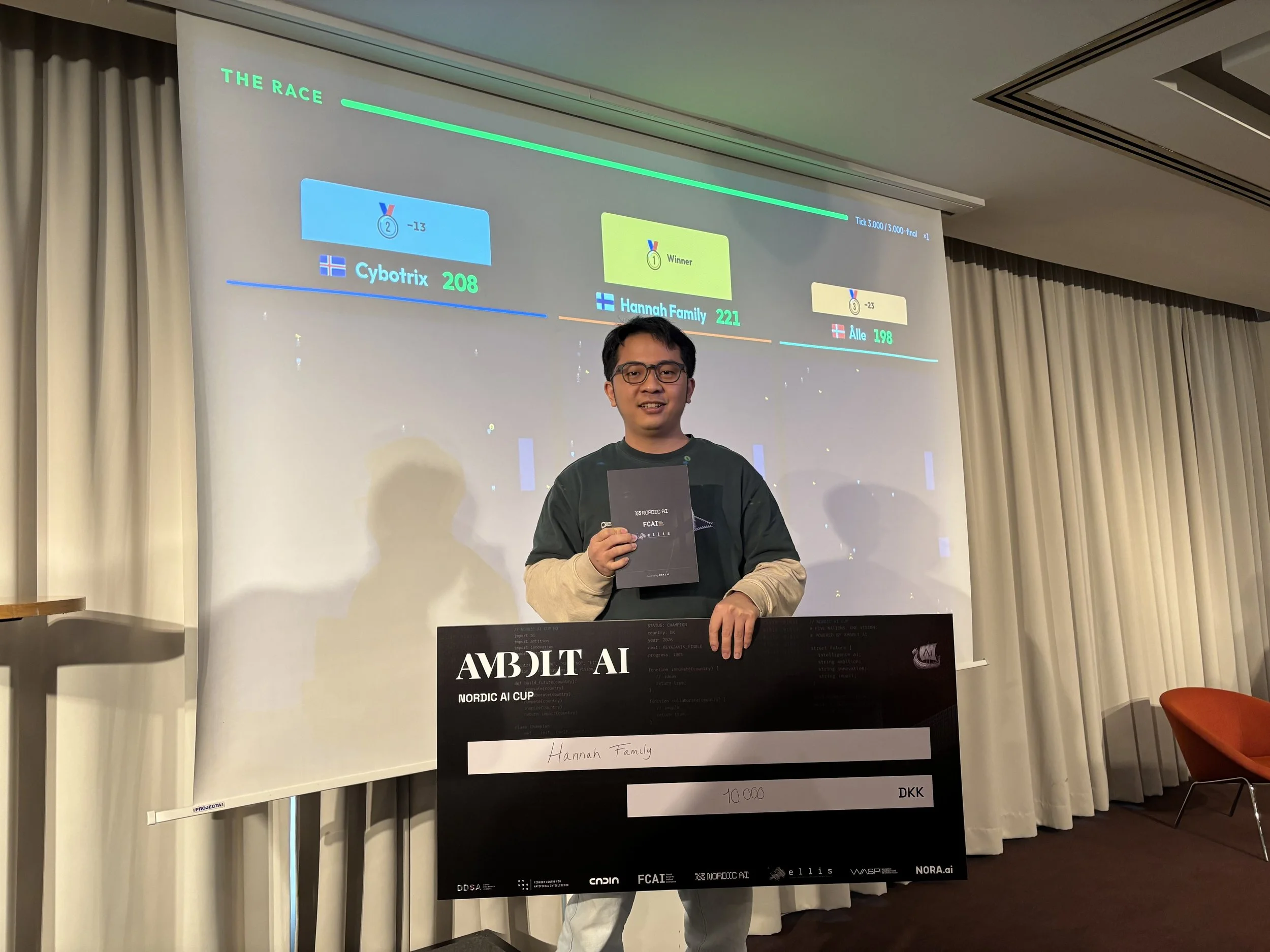
Team Hannah Family at the Nordic AI Cup. Photo: Kaisa Pekkala/FCAI
What was the Nordic AI Cup final like and how did you feel during it?
The final was an intense 24-hour experience, and I had a frustrating start. Network problems cost me about two hours, so I was already behind before I could properly get going. With such a short competition, that felt like a significant loss.
Once things were running, it became a continuous cycle of ideas, experiments, and decisions. Later that night, I left my AI agent working, put my computer in the bathroom, and went to sleep. It continued running experiments and submitting validation tests overnight.
There was a funny detail afterwards: the activity statistics suggested that I had slept less than anyone else—only fifty-something minutes. In reality, my agent had been doing those experiments and submissions while I was asleep! The statistics were tracking my system’s activity rather than my actual sleep.
Winning was a very satisfying ending, especially after that difficult start.
What was the task in the Nordic final and was there anything especially hard, easy or surprising?
The final had one task, Robot Robbers. We controlled five robots that collected cash bags and delivered them to drop spots while avoiding seven pursuers called “scrooges.”
The basic rules were easy to understand, but their interactions created difficult decisions. Delivering several bags together earned extra rewards, but carrying more bags slowed a robot down and made it easier to catch. Coordinating the robots mattered much more than simply finding the nearest bag.
One surprising opportunity was that being caught without bags carried no score penalty and granted temporary immunity. Empty robots could therefore act as decoys, drawing pursuers away from robots carrying cash.
My final solution combined a planner for routes and robot roles with multi-agent reinforcement learning that decided when to follow the planner and when to deviate. The hardest part was making improvements work consistently across unfamiliar maps.
You competed alone against teams with multiple people. How did you manage?
I competed as an individual, which gave me freedom to change direction quickly, but also meant taking responsibility for everything—from strategy and experiments to deployment.
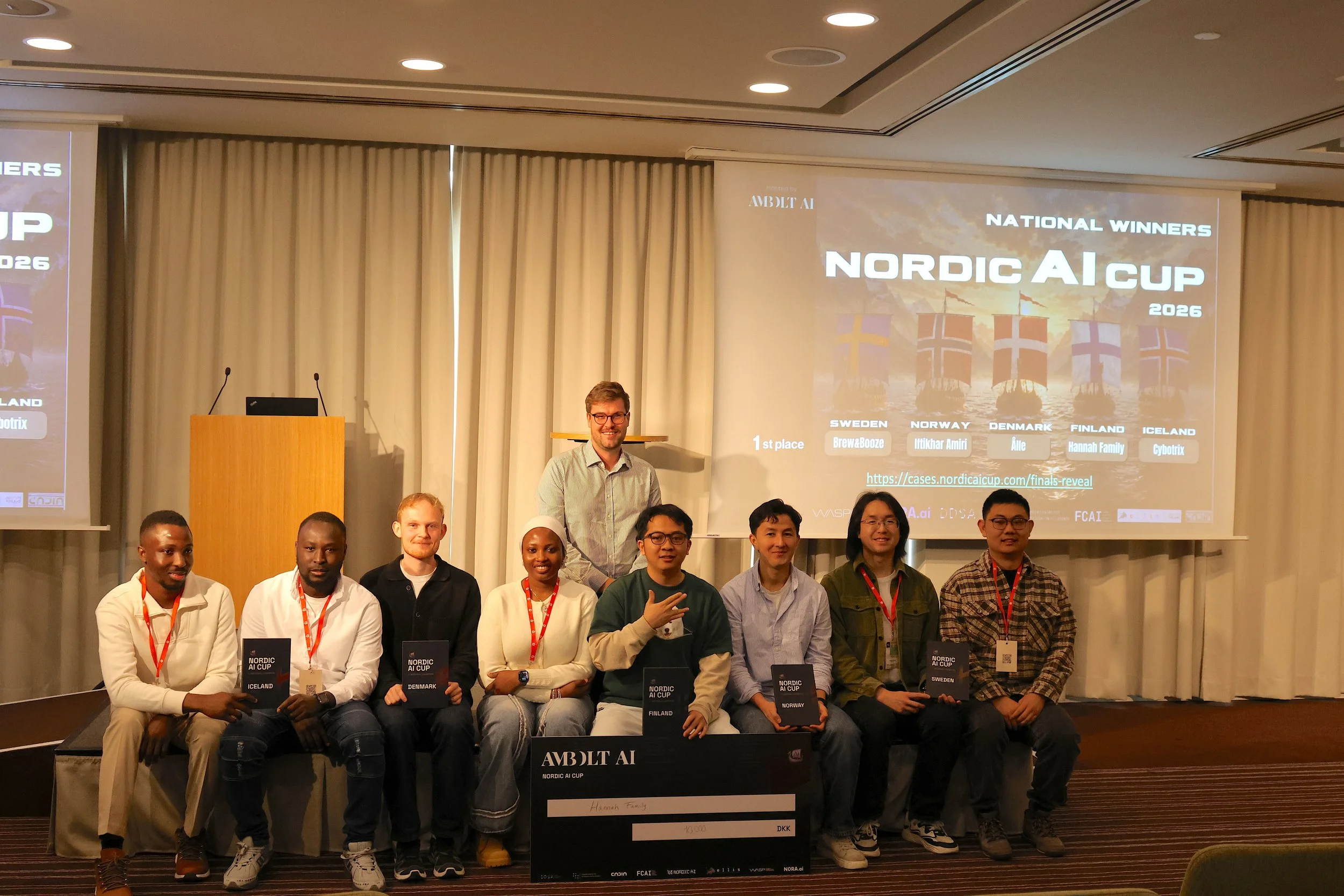
The Nordic AI Cup teams with Yue Fang at the center. Photo: Kushtrim Visoka/NORA
In practice, I worked with several AI coding agents exploring different directions. That introduced another kind of teamwork: I needed to give clear tasks, coordinate experiments, check their claims, and decide what to keep. They could continue working overnight, but their results still needed careful review.
A human team brings different perspectives and shared judgment. Working with AI agents gave me considerable experimental capacity, while leaving the responsibility for the overall direction and final submission with me.
How did the Nordic final compare to the Finnish national competition?
The national round lasted about four days and covered three very different problems: a survival simulator, object detection in drone footage, and understanding recorded medical conversations. The final compressed everything into 24 hours and focused on one problem, so it was narrower but allowed much deeper exploration.
The three national tasks also exposed the differences in my own experience. Computer vision was largely unfamiliar territory for me—I knew the basics of convolutional neural networks but had little practical experience beyond that. Even though I spent a substantial amount of time on the drone challenge, the result was still below what I had hoped for. It was probably the task that stretched me the most.
I have been exploring frontend and backend development, machine learning, and personal programming projects since my undergraduate years. That background made the reinforcement-learning and speech-and-language tasks feel more manageable.
The pressure was different, too. In the national round, I had to divide my attention across three problems. In the final, everything depended on one evaluation game on an unseen map, with the result hidden until the ceremony. That made choosing a reliable final version particularly stressful.
What is your own research about and how does it relate (or not) to the hackathon tasks?
I work on quantum geometry phenomena in condensed-matter systems. My research involves both experimental and theoretical work, so I regularly move between understanding physical mechanisms, carrying out experiments, and developing computational models.
I also use AI agents in my everyday research to help automate experimental workflows. This has greatly accelerated my progress and given me practical experience in breaking work into clear tasks, coordinating agents, and checking their results.
The hackathon topics were different from my research, but the working habits transferred well. In both settings, I need to understand a system, formulate a useful hypothesis, design a test, and decide whether the evidence supports it. The competition brought those familiar habits into a much faster and more concentrated setting.
Much of my preparation came from my existing experience with programming, scientific computing, and machine learning. Those skills helped me learn unfamiliar tools quickly and organise experiments under time pressure. The national competition taught me how much deployment, reliable testing, and experiment management mattered. By the final, I had a clearer workflow for comparing candidates and checking that the deployed system behaved as expected.
What did you learn from the Nordic AI Cup experience?
One of my biggest lessons was how important human intuition and judgment remain when working with powerful AI agents. They can implement ideas and explore alternatives quickly, but choosing a useful direction and interpreting the evidence still requires thought.
I also learned the value of building a trustworthy evaluation process early. A single good or bad game can be misleading. Comparing candidates across many fresh maps helped me decide whether an improvement was real.
Finally, the competition reinforced the value of combining approaches. In the final, a strong planner provided a foundation, and reinforcement learning added useful flexibility. Many attractive ideas failed testing; being willing to discard them was an essential part of the process.
The Nordic AI Cup final was held during Nordic AI Meet. What were your takeaways from that symposium?
One experience that stayed with me was hearing Iceland’s President, Halla Tómasdóttir, speak at the meeting. Listening to her made me reflect on how profoundly this wave of AI could transform society.
My takeaway was that governments need the courage to move forward while keeping a firm hand on the helm. We need to embrace technological progress and remain clear about the direction we want it to take and the people it should serve.
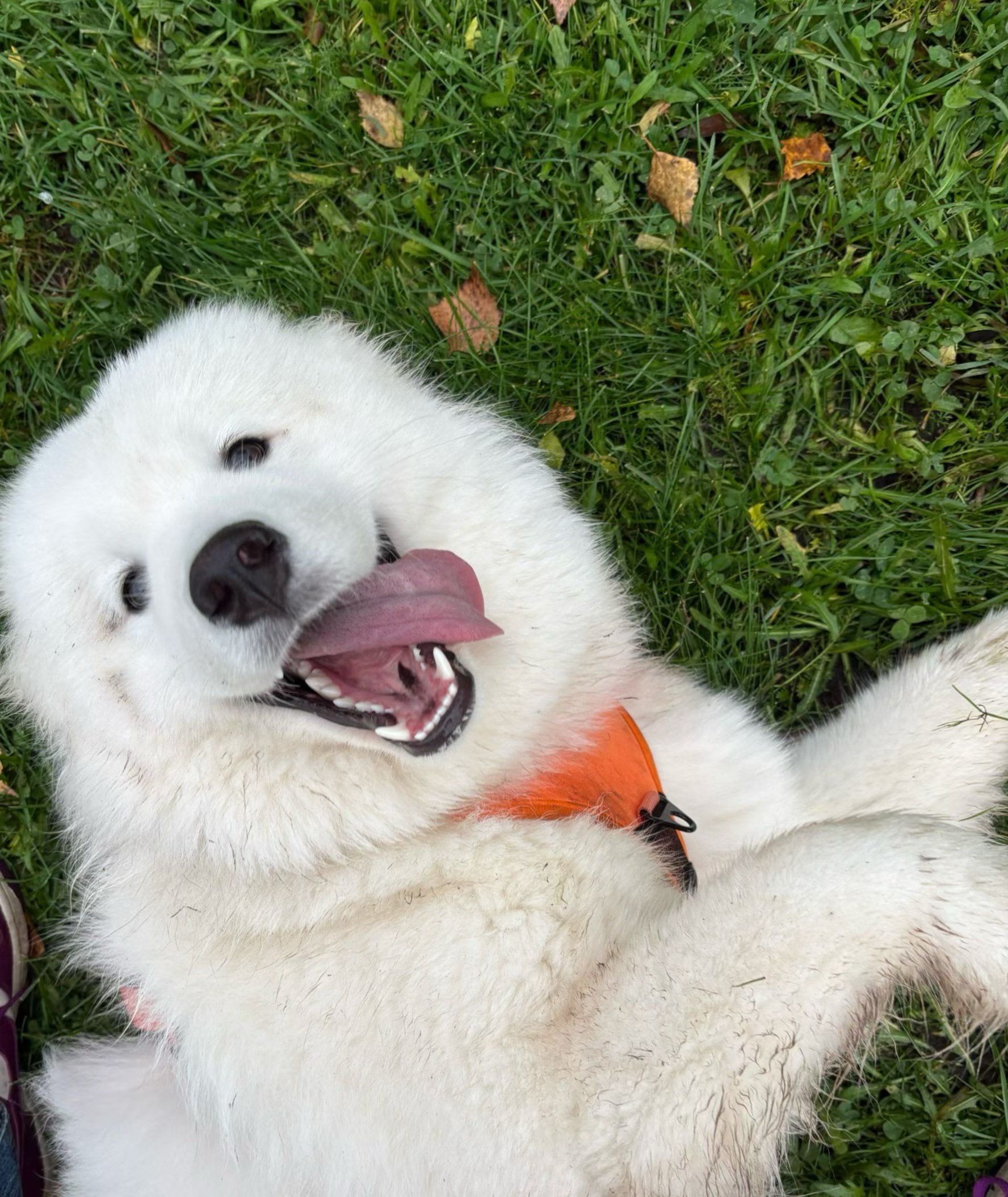
Hannah. Photo: Yue Fang.
As a young researcher, I came away feeling that young people need ambition and ideals more than ever. We have an opportunity to help shape this transformation, and we should think seriously about what we want to contribute.
I found her leadership inspiring. I believe the world would be a better place with more women leaders like her.
Your hackathon team was called “Hannah Family”. Who is Hannah and how did they participate in the hackathon?
Hannah is our eight-month-old Samoyed, whom we got in Tallinn. Our team name, Hannah Family, comes from her.
She is very gentle and remarkably understanding. When I stay up too late, she reminds me that it is time to go to bed. She likes sleeping beside my bed, although she is equally determined to wake me early in the morning when she needs to go outside!
She never bites anyone and hardly ever seems to get upset, even when I tease her while we are playing. She brings a lot of warmth into my life. I love my Hannah very much, and I am happy that her name became part of this experience.
What are your thoughts about your future career in the AI field?
On the first day of my visit, I had the chance to explore some of Iceland with Andreas Berre Eriksen, the CEO of Ambolt AI (the company that organized the Nordic AI Cup). We talked about many things, and those conversations made me think more seriously about entrepreneurship as an important possibility for my future.
I would love the opportunity to help build the Nordic AI industry—to turn ideas and research into useful products and companies and contribute to the region’s development. I am especially fond of Finland, and I would be very happy to build something meaningful here.
The competition gave me technical experience and confidence, and it also opened up new possibilities for what I might do next. I am grateful to the organisers, the Nordic partners, and everyone who made those opportunities possible, as well as Aalto for the computing resources that supported my experiments.
Read more about Nordic AI Meet 2026 here.